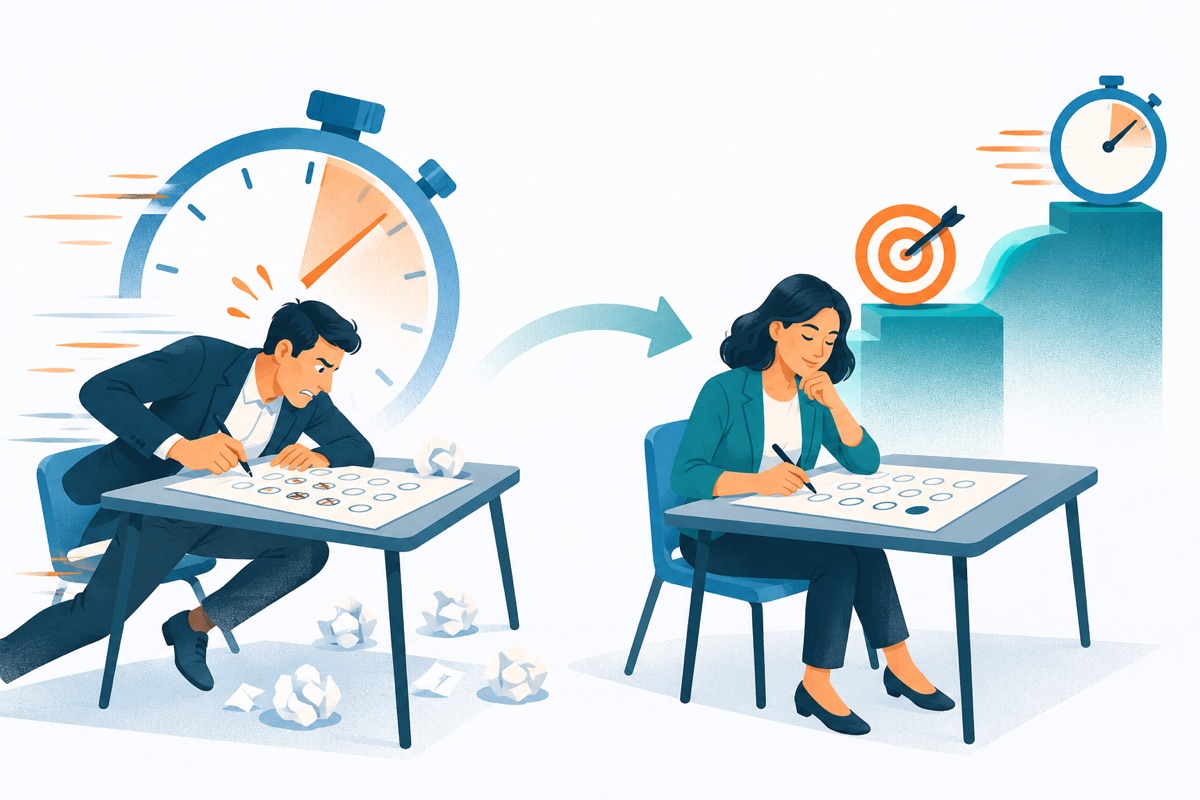
Studying on Your Phone Is MOSTLY Fake Studying

You're on the train. Thumb out, coffee in the other hand. You tap through eight Quant questions between two stops, get six right, see the little green checkmarks and feel GREAT. You studied today. Box checked.
Here's my verdict: most of that was fake studying. Not all of it. MOSTLY. And the fake part is quietly training habits that will cost you points on Test Day.
I know why you do it. You have a job, maybe a family, maybe a boss who sends emails at 9 p.m. The phone is right there. The 20 minutes on the train are right there. Using them feels smart. The problem isn't the time. The problem is what you're DOING with it.
You are training for an event you will never take
The Executive Assessment (the 'EA') is a 90 minute test with three 30 minute sections. Integrated Reasoning has 12 questions that make you pull facts out of tables, graphs and short passages. Verbal Reasoning has 14 questions. Quantitative Reasoning has 14 questions. Each section is scored 0 to 20, all three count the same, and your total lands between 100 and 200. The test is adaptive section by section, which means it adjusts to how you're doing. You can see the full layout on GMAC's assessment structure page.
Notice what is NOT on that list: a four minute burst of tapping while standing up, holding a coffee, half listening for your stop. On Test Day you sit for 30 focused minutes, three times in a row. Every phone session trains the opposite: short, distracted and with no pencil anywhere near you.
Think of a runner getting ready for a marathon by sprinting to catch the bus every morning. He's moving. He's sweating. He is NOT getting ready for mile 20.

The habits your phone is building
Stop reading for a second. Think about your last phone session. How many of those questions did you work out on paper? I'll bet the answer is zero. Here's what that zero costs you.
- You do the math in your head. There's no room for notes on a phone, so you don't take any. On an easy question you get away with it. On a question with three conditions, you drop one, and you never even know you dropped it. INSTEAD: Every question gets worked on paper. Every one. Writing down what the question gives you isn't slow. Rereading the prompt four times because you forgot a detail is slow.
- You skim. Small screen, long prompt, scroll, scroll. The Verbal section mixes Sentence Correction (fix the grammar and meaning of a sentence), Critical Reasoning (figure out what helps or hurts an argument) and Reading Comprehension (answer questions about a passage). All three punish skimming. INSTEAD: Read each prompt once, carefully, and take notes as you go, so you can start answering the moment you finish reading.
- You tap the answer that 'looks right.' Tapping is fast and cheap, so your choices get fast and cheap. That's a gut habit, and the people who write this test build wrong answers that look right on purpose. INSTEAD: Before you pick, prove it. Test a value. Test an answer. Cross off what you've ruled out.
- You never review. The checkmark shows up and you swipe to the next one. A right answer you guessed is just as dangerous as a wrong one, because you'll guess again on Test Day and the coin can land the other way. INSTEAD: For every question, right or wrong, you should be able to say WHY in one sentence. If you can't, that question isn't done.
- You train for 5 minutes and test for 30. Focus is a muscle. If you've never held it for 30 minutes straight, you'll fade on the last few questions of a section, and that's where silly mistakes pile up. INSTEAD: Several times a week, sit at a desk and do a full 30 minute block, the same length as a real section.
Watch the habit cost you a point
Here's a Data Sufficiency question, one of the two Quant formats on the EA (the other is Problem Solving, the regular kind with five answers to choose from). In Data Sufficiency you don't need the final answer. You only decide whether the facts you're given are ENOUGH to answer the question. Try it the phone way first: in your head, fast. Then try it on paper.
Be honest. Did your thumb go to A? That's not a math problem. That's a HABIT problem, and you trained it one tap at a time.
So what IS the phone good for?
I said MOSTLY, and I meant it. A phone is a fine review tool. Reread the notes you wrote about questions you missed. Go over rules you've already learned. Look back at why a trap fooled you last week. That's real work, and it fits on a train.
What a phone is NOT is a training tool. Training happens at a desk, with paper, for a real block of time. If you've been leaning on the phone because you think you don't have 'real' study time yet, read why waiting for the right time to start is the trap. Two focused 30 minute desk sessions in a week will do more for you than ten scattered train rides.
So you have to decide what you want MORE: to feel like you studied every day, or to walk in with habits that hold up for 90 minutes? You can't fully have both. Pick one.
And when Test Day gets close, this matters even more. The final week is for sharpening the habits you've built at the desk, not for cramming more taps into your commute.
Your challenge for tonight
Pull up the last 10 questions you did on your phone. Sit at a desk. Grab a pencil and paper. Set a 30 minute timer, the length of one real section. Redo all 10 on paper, with notes, testing values and testing answers wherever you can. Then, for each one, write a single sentence explaining WHY the right answer is right.
I'll bet at least one of your old 'right' answers turns out to be a guess you can't defend. Find it tonight. That one question will teach you more than a week of tapping.