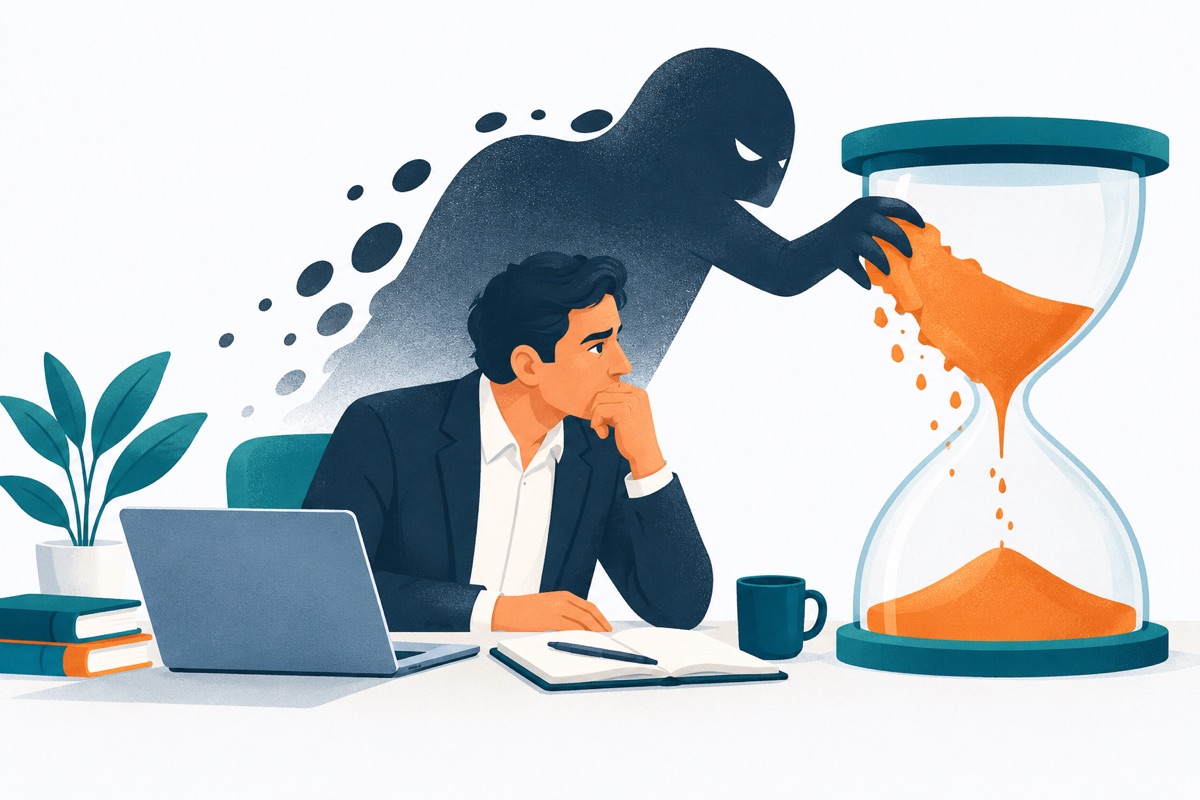
Adaptive Doesn't Mean DOOMED

Quant section. Question 2. You do the work, pick an answer and move on. Then a little voice says: wait, did I flip that sign? Now you're reading question 3, but you're not really reading it. You're still solving question 2 in your head. By question 5 you've decided the test "knows" you're weak and the rest of the section is a write-off.
I watch people do this every week. Here's my verdict: that one early miss did NOT sink you. What you did in the next five minutes might.
What "adaptive" means, and what it doesn't
The Executive Assessment is the test GMAC built for Executive MBA programs. It is adaptive, section by section. "Adaptive" means the test uses your answers to help decide what you see next. That's it. It is not a trap door that drops you into a low score the moment you slip.
Look at how the test is built. Three sections, 30 minutes each. Integrated Reasoning has 12 questions that mix charts, tables and text. Verbal Reasoning has 14. Quantitative Reasoning has 14. Each section is scored 0 to 20, your total runs from 100 to 200, and all three sections count the SAME. So one question is one piece of one section of a 40 question test. A section is built to measure you across all of its questions, not to pass judgment on one of them.
Now stop and think about this before you read another word. Do you actually KNOW you got question 2 wrong?
I'll bet you don't. Nothing on the screen told you. You felt shaky, and you turned a feeling into a fact. Plenty of the questions people "know" they missed are ones they got right.
The panic costs more than the miss
Say you really did miss question 2. That's one question. Now say the panic makes you sloppy on questions 3, 4 and 5, and those were questions you'd normally nail. You just turned one miss into four. The test didn't do that. You did.
That's the part people don't want to hear, but it's also the good news. The miss is in the past. The panic is a habit, and habits can be trained out. Don't get too down on yourself for feeling rattled. Everybody feels it. The test takers who score well have simply practiced what to do NEXT.

5 panic mistakes, and what to do INSTEAD
- Re-solving the old question while reading the new one. Your brain can't do both well. You end up re-reading the new prompt two or three times, and now you're behind on the clock too. INSTEAD: Draw a line across your scratch paper under the old work. Write the new question number. The line means DONE. Whatever is above it is gone.
- Rushing to "make up" for it. There is no catching up. Speed doesn't buy back a question. It just costs you the next one. INSTEAD: Run the same process you always run. Read, take notes, do the work on paper. The pace you trained is the pace that gets points.
- Reading the difficulty like a scoreboard. "This one feels easy, I must be tanking." Or "this one's hard, I must be fine." You can't read the test's mind, and trying to is pure distraction. INSTEAD: Treat every question as the only question on the test. Your whole job is the one on the screen.
- Dropping your notes to "save time." Panic makes people do math in their head. That's exactly when signs flip and 96 turns into 100. INSTEAD: Write MORE when you're rattled, not less. Notes keep a shaky brain honest.
- Carrying it into the next section. A rough patch in Integrated Reasoning has nothing to do with your Verbal score. Each section gets its own 0 to 20. INSTEAD: When a new section starts, start a fresh page and take one slow breath before you read the first prompt. New section, new score, clean slate.
What panic does to a gettable question
Here's a question a calm test taker gets right in under a minute. A rattled one, still thinking about the last question, picks the trap. This is Problem Solving, which just means a regular math question with five answer choices.
Here's a second one. This is Data Sufficiency: you don't have to find the answer, you only decide whether the facts you're given are ENOUGH to find it. The five answer choices are always the same.
Notice something? Neither question was hard. Both were easy to miss for one reason: rushing without notes. That's what panic does. It doesn't make you dumber. It makes you skip steps you'd never skip on a calm day.
Train the reset, don't hope for it
You will not "decide" to stay calm on test day if you've never practiced it. Calm is a skill, like a tennis player practicing the shot after a double fault. You train it when the stakes are low, so it shows up when the stakes are high. And if your heart is pounding, call it what it is: you're excited, because you've prepared for this exact moment.
So you have to decide what you want MORE: to feel bad about question 2, or to get questions 3 through 14 right. You can't do both.
Your challenge for today
Set a timer for 30 minutes and do a 14 question Quant set. Before you start, pick one question, say number 2, and decide that you "missed" it no matter what. When you finish it, draw your line, write the next number and keep going. Every time a question rattles you, draw another line.
Then grade the set. Look at the three questions right after every line you drew. How many did you get right? Did your notes get thinner? Did you re-read prompts? Write down exactly what changed. That list is your panic habit, in your own handwriting, and now you know what to train.